Fundamentals · 5 min read
Crowded market ≠ unwinnable
The founder's guide to winning a small piece of a big market
by Maya · @buildwithmaya
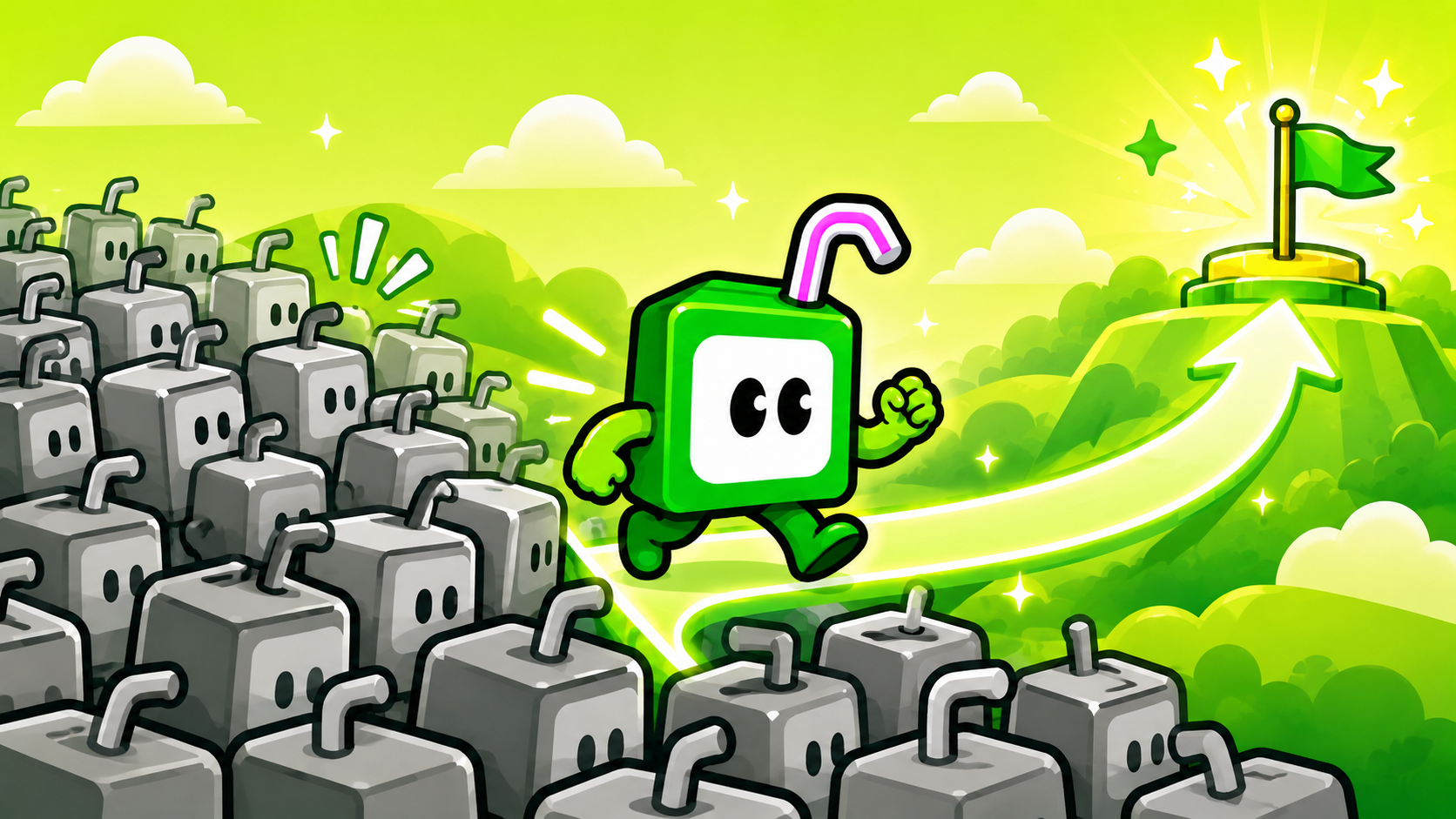
When I built my first product, I spent more time worrying about being copied than actually building. I kept it secret. I saw competitors and felt dread. I treated a crowded market like a threat to survive instead of a signal to read.
I had it completely backwards.
A crowded market means the demand is real. Someone already did the expensive work of proving people want this and are willing to pay for it. That's not a problem. That's a head start.
The issue was never being in a crowded market. It was trying to compete with all of it at once.
This is the framework I use now.
1. A crowded market is proof, not a warning.
Before you pivot away from a saturated space, ask what the competition actually tells you.
- Demand is real. Customers are already trained to pay for something in this category.
- Leaving because it "feels crowded" means walking away from a validated market into an unvalidated one.
- No competition is a red flag, not a feature.
Where saturation actually hurts you:
- Vague positioning
- Broad targeting
- "Slightly better" pitches
Those lose to incumbents every time. They have more budget, more brand, more time in market. Saturation is not the problem. Going broad is.
What to do: Write down three direct competitors. If they exist and have real customers, that's validation. Stay. The question is not whether to compete. It's where.
2. Go narrower than feels right.
When a market feels crowded, the instinct is to cover more ground. Appeal to more people. Hedge your positioning so you're not leaving anyone out.
That instinct is why most early products die.
The move is to go narrower than you think makes sense:
- Pick one person. Not a segment. Not a demographic. An actual person.
- Describe exactly where they are, what they've already tried, and why it hasn't worked.
- Get specific enough that you could find 10 of them this week.
This feels like you're leaving money on the table. You're not. You're making the game small enough to actually win.
The category leader is competing for everyone. You just need to be the obvious answer for one person first.
What to do: Write one sentence: "[Person] is trying to [do specific thing] but keeps running into [specific blocker]." If you can't fill that in without getting vague, you haven't picked your person yet.
3. Own that target before you touch anything else.
Most people rush this. They get early traction with a specific type of customer and immediately ask: "who else could we sell this to?"
Before they've locked in the first group.
You'll know you've actually locked a segment when:
- Your customers know each other
- Referrals come in without you asking
- Your sales conversations feel like the same conversation
Signs you haven't done this yet:
- Your pitch shifts for every new lead
- No referrals
- Sales conversations feel unrelated to each other
That's a focus problem. The answer is to go more specific, not to expand.
What to do: List your last five customers. Do they share a job title, industry, problem, or situation? If the answer is "kind of," you haven't locked the target. Find the common thread. Make it the only thing you sell to for the next 60 days.
4. Your real competition is inertia, not another product.
Common mistake: you identify competitors, build positioning around why you're better, wonder why it's not landing.
The issue? "Better than competitor X" is rarely the decision your customer is actually making.
Before they compare you to another product, they're comparing you to doing nothing.
Start by listing what your customer was doing before you existed:
- The spreadsheet they built themselves
- The manual process they've been tolerating
- The Slack channel where someone posts reminders
- The "we've always just done it this way" answer
That is what you're actually competing against.
Use this template:
For [specific person] who [specific pain], [your product] is a [category] that [specific benefit]. Unlike [what they currently do], we [the one differentiator that matters].
If that doesn't come out specific, the positioning is not finished.
5. Pick one distribution channel and actually learn it.
Sharp positioning and a clear target still don't grow a business if no one finds you.
In a saturated market, the standard channels are already expensive:
- The category leader owns search
- Well-funded competitors are outspending you on paid
- "Build an audience" runs on a timeline most early builders don't have
What actually works early: find one distribution advantage you have real access to right now.
- A community you're already part of
- An audience you've built
- A partnership that puts you in front of your target
- A referral loop baked into how the product works
- Manual, unscalable outreach until you learn what converts
What to do: Write down every distribution path available to you today. Not ones you could theoretically build. The ones you have now. Circle the one where you have an actual unfair advantage. Commit to it for 90 days before evaluating anything else.
6. Expand by following the thread, not chasing volume.
Once you've locked the first segment, you have something most early companies don't: proof.
- Customers who chose you over inertia
- Referrals happening without you asking
- People who can describe your product better than you can
That proof is what opens the next room.
Customers in segment A talk to the people in segment B. The reputation you build in one tight community becomes the credibility signal that makes the next community listen.
You're not expanding randomly. You're following a thread that already exists.
What to do: Before you open a new segment, answer this: can your current customers describe your product in one sentence without prompting? If not, you haven't locked segment one. Do not expand until the answer is yes.
Before you move on any crowded idea, answer these five questions.
- Is there existing competition in the space? (If no, that's a red flag, not a feature.)
- Can you describe your exact target customer in one sentence, including their situation and the specific moment the problem peaks?
- Do you know what they were doing before you existed, specifically?
- Have you picked one distribution channel and committed to it for 90 days?
- Are your current customers referring people without being asked?
If the answer to any of these is no, you know where to work next.
If the answer to all of them is yes, you're not in a crowded market anymore.
You're in one room that you own. Expand from there.